August 31, 2007

ON THE SIXTH DAY...

Another Residential Fantasy (2007) by Dean Monogenis


Essay by David Gibson

The art world becomes a slumbering giant during the summer months, only to roar awake right after Labor Day. Artists spend their time in studios and gallerists perhaps in the Hamptons, but they all return to familiar stomping grounds when the bell tolls for Fall. This year there are 155 openings on the first week of September, half of that number on Thursday, September 6, when a virtual deluge of gallery receptions sweeps New York from Chelsea down to the Lower East Side. An air of overall festivity accompanies a month when there are more parties than one can shake a stick at, counting both opening receptions and after-parties.

Staircases (2003) by Wolfgang Laib


Tracings Up to the L.A. River (2005) by Ingrid Calame


Exciting openings include Wolfgang Laib’s move from Sperone Westwater to Sean Kelly, featuring another of his totemic installations in which house or temple-like forms are shaped out of culturally loaded materials such as rice or pollen; Ingrid Calame’s third exhibition at James Cohan gallery, in which her paintings, originally modeled on photographs of grease stains found on city sidewalks are now combined together on large canvases and intermingled visually to complicate and enrich their resemblance to rorschach prints; Maya Stendhal Gallery features a solo exhibition by Shigeko Kubota, the wife and longtime collaborator of early video and Fluxus pioneer Nam June Paik, who in a Lee Krasner moment of her own, nearly two years since Paik’s passing, presents her own work as part homage and part idiosyncratic thumbprint on the art of her own era; last but not least, Stux gallery presents in its main gallery a series of paintings by Dean Monogenis in which the visual languages of architecture and urbanism depict utopian vistas that also communicate a painter’s love of form, as modulated between sensible and practical edifices, the spatial and structural encounters of city life, and a reorganization of the painterly landscape.

Continental Drift (2006) by Jon Elliott


Iris (2005) by Heather Bennett


Close to the old SoHo and in its own way a rebirth of the East Village scene of the late Seventies to mid-Eighties, the new Lower East is the answer to many an art world denizen’s prayers. Though it has been in existence for nearly a decade, the area received scant critical attention until it was announced that The New Museum would reopen at 235 Bowery on December 1. There has been a mad rush, partially fueled by speculation that the LES will be the next big thing, by the demands of real estate, and by a nostalgia for the days when the art scene meant Downtown. On September 6, there are nine openings in the area, ranging from “All the Way” at Luxe Gallery, a gallery known primarily for photography and video, moving here from 57th Street with works by Ellen Harvey, Pia Lindman, and Heather Bennett; and his close neighbor, Smith-Stewart with Yiva Ogland’s retrograde self-portraits of herself as an 11-year old, both infantilizing her current identity while promoting a fetishized view of youth that proves especially auto-erotic in ways comparable to Nabokov’s “Lolita” or the paintings of Balthus. 31GRAND presents Jon Elliott’s “Continental Drift” in which exhaustively macabre depictions of a post-Armageddon world refuse to deny a romanticism connected to the natural world. In a similarly epochal attitude, Zach Harris’s “Pagan Dirt” at Never Work depicts ziggurat forms within handmade frames which maximize upon an inherently fanciful, even comically heroic portrayal of ancient edifices and yet unexplored mountain ranges.

Zach Harris


In response to queries regarding the efficacy of opening on this date, most gallerists had matter-of-fact answers that reflected the timeliness of the new season and a regard for how art fairs and religious holidays might play havoc with their desire to showcase as much good new talent as possible. Amy Smith Stewart said “I thought it was a good idea to get things started on the earlier side and take advantage of all those well-rested, well-vacationed minds.” Siobahn Lowe, director of Never Work, who is excited to be opening her first gallery, stated that “The smaller, less polished spaces and the grittier streets stand in contrast to the sleek architectural spaces and commodity driven approach of many Chelsea galleries. On the Lower East Side there is a return to the sense that artists (and having a good time) are of primary importance - which I think is a strength that will keep creating better and bolder work here. I think the New Museum is obviously a strong, downtown ally to have in the neighborhood and hopefully will just bring more people down to visit.”


Sean Kelly Gallery
528 West 29th Street – 212.239.1181 – info@skny.com

James Cohan Gallery
533 West 26th Street – 212 714 9500 – info@jamescohan.com

Maya Stendhal Gallery
545 West 20th Street – 212.366.1549 – info@mayastendhalgallery.com

Stux Gallery
530 West 25th Street -- 212.352.1600 -- stux@stuxgallery.com

Luxe Gallery
53 Stanton Street -- 212.582.4425 – info@luxegallery.net

Smith-Stewart
53 Stanton Street – 212.477.2821 -- info@smith-stewart.com

31GRAND
143 Ludlow Street – 212.228.0901 -- gallery31grand@earthlink.net

Never Work
191 Henry Street -- 212.228.9206 -- siobhan@never-work.net

October 21, 2006

CULTURE SHOTS

Friday, October 20: ROSEMARIE FIORE at Winkleman Plus Ultra


The artist greeting her fans


David Packer and Margaret Lanzetta
arguing the benfits of summer over fall


Dealer Ed Winkleman and gallery artist Jen Dalton


August 05, 2006

CULTURE SHOTS

August 4, 2006: “Twin Reflections: Brian Getnick & Rob Carter,” curated by Leah Oates at Dam Stuhltrager Gallery, 38 Marcy Street


View upon entering the gallery of "Twin Reflections" installation


Brian Getnick sculpture, exterior view


Brian Getnick sculpture, interior view


Rob Carter video


Rob Carter photograph


Brian Getnick wall installation, wide view


Brian Getnick wall installation, bug's eye view


The red tresses of Nurture Art's Karen Marston and a very juiced
Don Carroll of Jack The Pelican Presents exchanging neighborhood gossip
...!

June 20, 2006

BETWEEN THE LINES


Amanda Church at Michael Steinberg Fine Art, New York, May 25-June 24, 2006


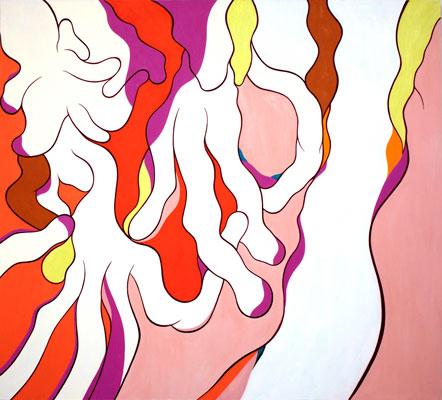
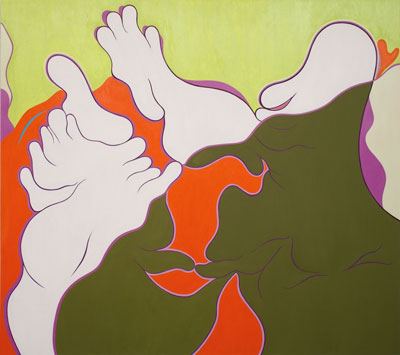
The purpose of imagination is to see. Amanda Church understands that it takes very little to allow us to depart from the real into the imagined, and she provides these elements in her paintings as an entry into the mystery that separates the sensory from what is useful in everyday life. The type of experience they engender can be found easily in nature, like looking for the constellations in the night sky, or divining meaning from tea leaves. Three elements are actively at work in these images: lines, color, and perspective, and each complicates the other two. Looking at “Flash Point” (2006) for instance, we may at first see only areas of color and forms that suggest hands, feet, and the profile of a human face. The shapes inferring human form are not depicted straightforwardly, but as if a picture was taken from so close to its subject that all the details became blurred. Also, Church cuts across the “objective” of the painting with a scrim of other lines that disjoint it, as if the camera lens itself were blurred or cracked. Then she also adds alien colors to the mixture, which create visual areas that war with one another, tempting us to look closer while always obfuscating the process that leads to visual clarity. In a different painting, “Tangled Web” (2006), we are presented with a visceral mess of veins and tendons, the interior workings of the human body that are palpably human though in themselves esthetically ambiguous. It is far more difficult to perceive intimations of physical reality in abstract forms when they emerge from the popular imagination out of issues of Nature magazine. Yet the tension of these lines and bodies, when combined with a playful and tentative use of color, overwhelm the interior vertigo we may encounter. It is perhaps easier to see human elements in nature but more fulfilling to realize the human in an effort to create beauty from the most oblique perspectives painting can offer.

April 26, 2006

Found Performances


by Marcy Brafman


I went to see Marni Kotak's performance piece at Artists Space on November 21, 2005. I really didn't know very much about her work aside from the live systems Installation that was in place at the "market value" show at cuchifrito's in June 2004. David Gibson curated that show and my painting "Maiden w/ Sword & Shield (Collection of Buxton & Lisa Midyette) was in it. I was intrigued by Marni's site piece at that time as I am a sucker for paper mache. It really made you think about the origins of the essex street market (where Cuchifritos operates out of the southeast corner) as it was all pushcart and hand-wrought signs. Marketing at its most basic.


So here I am at Artists Space, of course I am a little late, and Marni is playing in a sandbox and handing out candy. Big perception warp. I snag a Baby Ruth and the next episode is a harrowing depiction of child abuse. Marni is tethered to a radiator with black theatrical sash. She is in a child's PJs and is writhing mightily against her bindings. In the background is playing a horrific track of monster mommy screaming the same things over and over again: Stop screaming like an animal...If you act like an animal you'll be treated like an animal...If you weren't moving your arm around like that it wouldn't hurt so much...

In another scene, Marni is an abused wife, an artist who is married to a military recruiter who resents her trying to create her work.....it becomes exceedingly violent, terrifyingly so. the most frightening part is that he sees himself as the victim....it points up the struggle so many women artists have in creating their work but trying to sustain a relationship with a man.


There is a funny and creepy scene with another woman in which they are playing dollhouse with Barbeys (I think they are supposed to be 11 or 12, on the cusp between little girlhood and womanhood), which becomes a teen date rape scenario.

There is one with an altar, and another with a teenage vanity, and another is a portrayal of a bi-polar personality.


I left the evening shaken and stirred with the hope that not too much of Marni's work is autobiographical. That being said it was a very powerful and very resonant evening of performance which gave me a great deal to think about.

MARCY BRAFMAN
mhbrafman@gmail.com

September 13, 2005

Innocence Bound


Mike Cockrill: then again, at 31GRAND, Brooklyn, October 15-November 14, 2004


by David Gibson


When we were young, the world seemed completely open to us. It was filled with promise, and we were excited - if uncertain - about what would happen. In many ways, the process of becoming a human being is similar to that of developing an artistic sensibility. We begin as clean slates and slowly, through trial and error, aided by an interiority of uninformed impulses, develop a sensibility which begins to resemble a set of convictions, allowing us to proceed within our purview and ultimately beyond. For these processes to develop, a degree of projection is needed, and art provides just such an outlet.

The paintings in Mike Cockrill’s solo exhibition, Then Again, narrate a period of youth during which a variety of anonymous characters – in this case, mainly young girls - experience life in all its wonderful complexity. The entire duration of life is neither available to us through these images, nor does Cockrill consider it useful nor revealing to narrate a life's full span. He focuses on the interval between two greatly dramatized yet nominally understood states: childhood and maturity.

The word "innocence" describes a state of absence, a blissful ignorance waiting to be filled with ideas and experiences from which a suitable set of convictions can be formed. It denotes a lack of culpability in matters of adult moral agency, and yet it also presents us with a value which is constantly under review. It is hard to know what innocence means, except as a symbolic embodiment of everything we know unlearned from the start. Its opposites are well known to us: lust, evil, or knowledge.

Yet the innocent present us with a paradox of unfathomable limits. Their openness is like a weapon, a standard with no clear message. They are closer to beasts than men. The innocents that Mike Cockrill portrays are for the most part children. In some cases they are quasi-adult children, or young women, or adult women transforming from knowing adults into pawns in dramas where adult agendas are instantly suspect.

This is a complex exhibition, instantly adding to the variety of forms in Cockrill’s previous body of work, and, aided by a will toward multivalence and idiosyncrasy, successfully presenting characters emerging from stereotypes into full-blown personae. The most easily perceived works are four large canvases, 5 x 4 feet in size, depicting dramas in which a female persona, whether a mother, daughter, or beloved childhood companion, symbolizes an alteration in childlike consciousness - a dream of simple idealism, attraction turning into awe, or bittersweet love from afar. Readily informed pictorially by religious, mythological, and propagandistic sources, these transformations prove no less effective for Cockrill's use of a large range of visual agendas. The evidence of such influences proves how important they are from a societal level down to a personal one.

In the first of these large canvasses, Men with Arrows Plan Our Future (all works 2004), we are presented with a scene out of the mists of childhood, a happy accident that leads one from ignorance into lust: a young boy hangs around with his mother as she completes household chores such as laundry. When she kneels down to lift the basket, he is inadvertently given a full view of her womanhood, including her legs above the knees and her full breasts. Her eyes averted while at her task, she is both unconscious of his sudden and instinctually informed attentiveness while simultaneously becoming the vessel for his desire. The momentous quality of such a simple event is underscored by the depiction of a space rocket’s final section landing in the ocean, accompanied by a billowing parachute and identified with a large black arrow like the type appearing on NASA flight charts. Besides this image, there are also background images which include a living room couch and a large, ranch-style suburban home - stereotypically American - combining the aura of a traditional family with the generic style of mass-produced domesticity.

In another large canvas titled The Iliad, Cockrill depicts a young girl caught in the whirlwind of her own deeply repressed emotions. This painting does not contain a single dramatic event, but rather attempts to capture the emotional tenor of her world-view. The girl is spindly and fragile-looking, dressed in sensible shoes, knee high striped socks, a zipped white windbreaker, and thick black frame glasses. She stands in the center of the painting with an assortment of images surrounding her in the manner of a high-school scrapbook: two cute puppies; her younger brother drawing in a book; a little Dutch or Amish boy cranking a town water pump; military jets booming through the sky; an aircraft carrier moored in port somewhere far away. While her mother paints the blank background around the edge of her face with a whitewash, a mysterious male hand covers the bottom half of the picture with the same substance. The little girl stands on a large image of an aircraft carrier that is made to seem less realistic than the ones depicted in separate frames. It seems to be almost a chariot for her, to carry her through anxiety and fear into safety, or which functions as the presence of a father - a long lost warrior out to sea - who will return to complete her life as she can never do on her own.

A third large canvas, Ascension, presents a woman in the throes of an excessive emotional state, though one which expresses an opposite state of mind from the previous one described here. The woman in this picture is older, and has the Rubenesque body of someone who has born a few children. She is clad in a gossamer teddy, and surrounded on all sides by gaily singing boys and girls, a large, cheerful country home with a spacious front yard, as well as by a jet plane and the small background image of a woman packing a suitcase. Although all is depicted in straight lines and bright colors, we can only come to certain conclusions here. The painting represents an actual and symbolic celebration of the artist’s own mother: surrounded by her beautiful and adoring progeny, she is portrayed not only as the successful proprietress of her household, but also as a woman both sensual and idealistic who dreams of both further richesse and future travel - an independent departure from her current circumstance into one of as yet unreckoned possibility. Again, there is no father or husband figure present.

The Madonna of the Roses depicts a scene of mundane gaiety which is quickly transformed - by the excising of a single object - from one of camaraderie and youthful joy on the edge of desire, into one of spiritual awe. A young girl is skipping rope, holding in one hand a flower which perhaps the young boy at her side has just given her. In the midst of a single leap her ropes disappear and she is made to levitate: the frills on her two-piece jumpsuit fly up in the breeze while her gaze lowers down to the viewer, giving her a serenity and earnestness beyond her years. The young boy, dressed fancily for church with a white shirt and large bow at his neck, is caught in mid-sentence, either in the throes of religious ecstasy or love for his suddenly blessed companion.

A series of single portraits fills out the show, some on canvas in oil and others on paper in watercolor. Each provides an allegory or narrative which expands our ability to see in women and children what Cockrill sees. In The Good Child, a young girl prays before bedtime, her hands folded before her in the customary gesture. But instead of a solemn face dedicated to moral purpose, we see a girl whose love of God and trust in the truth of ritual brings her immediate joy - which Cockrill has dramatized by painting clown lips over the girl’s own. White and large with a slight outline of black, such lips make the girl into a primal force for unabashed glee, as well as a devout worshipper. Not My Rainbow, Dog Day Afternoon, Virgin in Spring, and The Rainy Day - each portrays a young girl or woman who is given to the contemplation of solitude. Some of these maidens seem to be taken from the images of melancholy characters that illustrate front covers of ten-cent paperbacks. Others seem lifted directly from literature as varied as Little Red Riding Hood, Heidi of the Hills, Nabokov’s Lolita or from the paintings of Balthus. Despite their overly generalized imagery, and sampling from multiple sources, these portraits lose nothing in the way of emotional message or urgency, and serve to reinforce our attentiveness to the culturally-informed contexts of Cockrill's idiosyncratic perceptions on storytelling, emotional narrative, and idealization of women. In viewing these paintings, we look back upon a dim memory of a time when we were just beginning to actively form our sense of self. Moments of contemplation and accidental scenarios of loaded significance - even generalized periods spent under the sign of a particular impression or event - all contributed significantly to how we developed in our later years.

It’s clear to see that Mike Cockrill has a special love for women, and whether this originates from his own role as a father or the golden memories of his distant youth, it is the degree of parable in these images that charms and seduces us. Woman is the divine Other - a force for emotional and spiritual change. In our earliest years we are naturally dependent upon a mother figure. As we mature, it is to a mother or sister that we are drawn to make the first observations of newfound sexuality – as either a mirror or vessel for desirous projection. The resulting start of a new set of moral values also represents the loss of a previous, if unfulfilled, set of childlike values, in which the character of a family member may easily take on a degree of mythical significance. Each of these personae, individually or as a complementary set, represents an equal and opposite force to our own nature, which is then defined only by the choices we make and our evaluation of qualifying the general state of affairs surrounding and coloring such judgments. As Oscar Wilde once said, "the story of your life is not your life…it’s your story". Mike Cockrill reminds us of the importance of knowing the difference.


David Gibson is a native New-Yorker, art writer and curator with a lifelong passion for the artworld.

August 27, 2005

Sampling Identity


by David Gibson

Identity is the cornerstone of our being and the means by which we impose some small degree of order upon the world, which is always in a state of growth and flux. What we may or may not comprehend is that identity itself is likewise in flux, and though we may often hold to the belief that it represents a fixed quantity, we are hard-pressed to decide which elements define our individual ideas of our selves. In history, when mankind has been in a state of doubt, it has searched for symbols to represent the qualities it most admires or despises. Those first took the form of mythology, then later of religious devotion, and much later—and in some ways finally—the precepts of science. The journey through belief is itself a journey to self-knowledge, and it is through art that man has often found himself seated before not only a fount of valuable learning, but also before a mystery whose purpose has yet to be told.

Individual artists throughout history have created oeuvres that present pictorial views of reality which impress upon the viewer a regard for beauty and order, for depravity and chaos, and for the mystery and opacity of abstraction. A common thread between each of these aesthetic agendas has been that the works reveal a degree of symbolism that relates directly to our manner of approach, and not to the overt subject matter on view. We must be able to take from the work of various artists what is given, in the combinations of complex and hybrid meaning that are intended. Symbolism works best when it is connected to a depiction of reality that is loaded with varied degrees of context yet allows us to detach ourselves and consider a work’s themes without any expectation that it will fall in line, aesthetically or morally, with the mundane aspects of our daily lives. What art reveals is the connection between conscious and unconscious recognition, whether that relates to fantasy versus reality or to accepted versus taboo ideas and beliefs.

Carla Gannis utilizes the appearance of reality to create a context of transparent pastiche which ironically juxtaposes received knowledge with aesthetic phenomenon. Her characters are sampled from various cultural contexts, including her own life, art history, mythology, and the mainstream media; yet a working knowledge of the inner recesses and psyche of the artist's life may be necessary in order to gainsay the character of each image. Whether through individual choice or the agency of unseen forces, every character expresses a loaded and subjective vulnerability, either by appearance or mood, or by a transformation depicted in the physical situation. Likewise, the situations themselves, as paired with the actions of her characters, are made to represent a perverted perspective of the logic behind narrative and causality. This is achieved by her use of the "sample," a technique that is relatively new in cultural terms, though it is similar in effect to gene-splicing, when scientists combine, for example, the genes of different flowers to experiment with the physical consequences of crossbreeding. As a cultural process, sampling became popular in the early 1980s with rap music, in which musicians would take a passage of music from another artist's recordings and layer their own tunes or words over it. This began to occur in other musical forms over time. The synth-pop band Depeche Mode became especially well known for its practice of sampling such disparate sounds as spinning helicopter blades, shattering glass, or skidding car brakes, and adding them to a rhythmic or syncopated beat to form the backbone for their songs. In the age of digital culture, sampling has become a very accessible practice that allows artists to combine images from various origins and seamlessly meld them into an overt new reality.

Such is the case in Gannis's "Travelogue Series". The concept of narrative is a strong element in these works. Each of the images tells a story, and though very little is provided for the viewer to draw a conclusion, it is clear that there is more going on than what is depicted. The narrative that Gannis wants to show us is essentially a psychological one, in which factual details are not as important as emotional ones. Each story has to do with a strong psychic impression that she has held at one time or another. The degree of portent they hold and the manner of symbolism used to express that portent are the more telling qualities of her intention than anything more formal and explicit could suggest. For every period of emotional education in our lives there have been 'psychic turns,' moments of instantaneous clarity that have allowed us insight into the depth of our inner growth. Through these moments we are able to classify the movement from one state of being to another. From the inherent narrative quality of Gannis's imagery it can readily be surmised that she wishes to express the complexity of her issues in transit.

Because the sense of reality Gannis seeks to impart is necessarily complex, it obligates the viewer, when looking for meaning to take on the whole image, replete with all of its visual and contextual associations. We must start with the myths that are built into them, and work back toward a description of the commonplace. In WAITRESS, for instance, we have a figure that is clearly a woman, but the kind of woman we see depends upon the order in which we accept the various symbolic aspects of her appearance and the dramatic situation she inhabits. Her assigned role is given her by the work's title, but she is plainly more than that. She wears the costume of a comic-book super hero, her body naked from the waist up. In the area that would comprise her stomach and her womb, there is only a spine, with her stomach and womb neatly excised from the ideal representation of female form that she otherwise fulfills. The setting is a traditional diner with leather booths, a long red carpet down the middle, and red-and-white "Coca-Cola" signs overhead. The situation in which the waitress is posed provides another puzzling context. She is paused in midair, as if she were about to leap into action. It is clear that WAITRESS presents us with a complex symbol simultaneously representing different models of female identity. The character is swathed in identities that together show us how narrative can be created from the depiction of an emotional state, and conversely, how an emotional state can be projected upon the viewer which generates an empathic reaction that is both symbolic and personal. The character in this scene is clearly a symbol of strength, one that exists to heighten our regard for pedestrian reality, and yet she is no mean caricature, governed equally by idiosyncrasy as by heroism. She does not need to be involved in some cosmic clash or daring rescue to possess the rank we give her; her position as a mere wage slave presses this upon us. Her further state, in which she is deprived of the attributes that biologically define her and make her human, such as the need for sustenance and procreation. Gannis sets the stage for our reactions just as she manipulates the view. She wants us to understand that truth is not a one-sided coin, and that just as all persons can be symbols, such symbols can mean, and achieve, as much as individuals do in their private lives.

In LAST DAYS IN MEXICO we are presented with the scene of a crime in which there are three players, the villain, his victim, and a mysterious witness. The crime is a murder. A man in a dapper suit stands above a prone Pan-like figure with the furry body and cloven hoofs of a goat and the face of a woman. The setting is a large warehouse with one bright light high above on the ceiling, and the otherwise drab appearance of dirty white and industrial green paint. The Pan figure is joined in his fate by a naked woman with two moaning heads and wings that resemble those of a demonic butterfly. She is Hecate, queen of the underworld, a spirit who is present in the endgame of the hunt, and who presides over every event deemed a moral crossroads in life. She is a pagan figure, just as is Pan, and though he is a symbol of the decadence of late Greek society, she is a primordial figure who was once the Empress of Hell, predating even Hades himself. Her presence lends a sense of pathos to the death of Pan, and a vulnerability to the one human pawn here, who though he has been the harbinger of a certain decree of fate, is at this moment considering the efficacy of his role, lost in his houghts, thinking of the future.

A third and final example is THE BLUE CAR, another image that depicts a figure in the garb of a comic-book superhero, this one suggesting Superman, though in this case the character does not resemble our memory of him in the least. Our hero here is a small figure, curled into a fetal position as if sleeping, hanging upside down like a bat, with his cape wafting down to just above the surface of the earth. There is a lone witness to this event—a blue car that passes him in the middle distance—which makes us wonder about the identity of his spectators and of their intentions while he is both literally and figuratively 'wrapped up in himself.' We are made to feel a paternal or proprietary empathy for the sleeping hero, and a sense of dread for any unknown entity, even one provided by as innocuous a source as a simple automobile.

As Francis Bacon said, "knowledge is power." Yet knowledge comes to us from various sources, and identity is the sieve through which such gleanings are processed. If we can say, this is who I am, then we are inviting chaos and mystery into our lives. Yet the progress of history has shown us that there are many directions from which knowledge can be approached. There is the scientific method, which is primarily deductive, and which looks at physical details and makes assumptions that usually fall in line with preconceived notions. Alternately, there is the symbolic method, found in Gannis’s images, in which a vast and unforeseen psychic province is tapped through the use of complex narratives that introduce us to characters who are as opaque as their symbols. The narrative and the symbolic intersect in these images, obscuring any one path to understanding, and moreover, subverting the misconception that there can be only one story in each image. As a means of emotional education, they are thrilling and mysterious models for the shape of our common unconscious, and the transitional quality they impart proves a doubly rich context for the evolution of aesthetic perception.

Catalogue essay accompanying the exhibition "Carla Gannis: Travelogue" at Pablo's Birthday, 84 Franklin Street, New York, November 11 to December 7, 2004

Copyright (C) 2005.

March 15, 2005

The Public Death of Chris Kraus

Aliens & Anorexia by Chris Kraus, Semiotext(e) & Smart Art Press, Los Angeles, 2000

Review by Jen Hofer

Genre is like subjectivity: within certain confines, certain bodies (the book tending to be made of text printed on the page, the body of flesh and muscle attached to bone), it is almost infinitely elastic, mobile, mutable. Where our spiritual or formal ideal might be "the good" (cf. Simone Weil filtered through Chris Kraus), our physical or functional ideal might be "the possible," a non-sequential series of thoughtful and irreverent nudges against the limits of our confines, of our bodies. In such a context, it is quite possible that "the possible," or the extension of what is possible, would become our practice as well. Such is the case with Chris Kraus’ Aliens & Anorexia, a book which is a film within a novel within a philosophical exploration within a historical inquiry within a time-sensitive performative memoir within an artist’s manifesto within a social problematization of contemporary capitalism within a theatrical exegesis of public death, i.e., Alien invasion or anorexic practice, i.e., Changeable and changeling subjectivity.

The idea of movie is that each person enters as a character. Their faces on the screen contain their entire histories to that point but through the very act of entering the movie, these histories change, combine. The idea of movie is a powerful explosive will towards happiness (as Walter Benjamin said of Proust): emotional logic attained through a poetics of didacticism. (107)

In this sense, Aliens & Anorexia is a movie that partakes of an emotional logic which is alien, or anorexic, or both. "anorexia is not evasion of a social-gender role; it’s not regression. It is an active stance: the rejection of the cynicism that this culture hands us through its food, the creation of an involuted body." (163) something extraordinary is visited upon us when we are able to move outside ourselves (or so far inside ourselves—to the point of involution—that the inside becomes outside or our most private moment, our death, becomes public). "to question food is to question everything." (145) we become alien to ourselves, not outside subjectivity, but party to and part of a radically complex, unfixed subjectivity which bypasses the single, simple subject and trespasses over the supposedly unified borders of body and emotion. "then she became an alien, i.e., Someone who has changed." (15) the main characters in this textual film—Chris Kraus, Simone Weil, Paul Thek, Ulrike Meinhof, Ceal Davis, gravity, grace—are alienated, alien forces, acting in dissonant concert as chris kraus writes them to undermine any fixed or non-porous sense of self, subjectivity, genre, and what is possible to experience within these confines.

It could be that sadness is the girl-equivalent to chance. Chance has always been equivalent to sadness, it is an interior reality so physical and large there is no need to access it by studying the mathematical laws of permutation…like chance, emotion is a current that dissolves the boundaries of a person’s subjectivity. It is a country. Shouldn’t it be possible to leave the body? Is it wrong to even try? (98)

Second wave feminism—in some ways a movement based in an idea of the immutability of the body—at its most (and all too often) simplistic and essentialist, was content to state that the personal is political, thus bypassing any responsibility towards the social. For Chris Kraus, on the other hand, whose "sadness" prevents her from just calling herself a feminist so as to have better luck on the market (82), the emotional and the political together form an intricate body which acts within a theatrical experiential field, "a country that we enter through our bodies," (110), encompassing both personal history and communal history, rooted both in the material and the possible. In squat theater performances, "(i)nstead of scripting it, ‘a potential field of action was staked out.’ this unpredictability made reality alive, and much more immanently theatrical than theater." (10) the elasticity or porosity of the subject and the daily performances the subject moves through do not suggest a kind of atemporality of existence outside historical events and past occurrences, outside the material actualities of the world. Nor do they preclude completely over-the-top, alien experiences.

"Sand is water you can walk on, it’s time," Thek said later. These objects have a history. Just as the entire rehearsal process is embedded in performance of each actor in a play, the objects in the procession pieces vibrate with what brought them here. And yet they’re porous, waiting to be filled by what happens next, their interaction with the audience. (62)

The objects and the characters in a play (in experience) are countries populated by individual and systemic pasts. "he (Marx) was talking about the fact that every object in the world is a summation of itself, of every one and every thing that made it, of how it came to be." (127) there is no amputation—experience cannot be undone—and while anorexia or (as in Weil’s case) starvation may cause the physical body to waste away, the matter that constitutes subjectivity, "(H)istory, barely visible but shuddering underneath the translucent skin of the present," (178) is never erased. When we experience anorexia or alien invasion or Kraus’ writing, we are not removed from our bodies, from our histories; rather, our bodies become complex sites where much has happened and anything might happen. The body expands, engaging not in out-of-body experiences, but rather in extra-body or hyper-body experiences in which the alien future swoops down upon the history-laden body, making love with it, or making it present. Aliens and anorexia opens with the image of Ulrike Meinhof, a radical German activist who was imprisoned and then executed in 1976, channeled by the squat theater at the moment of her execution when she is visited by an alien who makes love to her, after which she "could state that my consciousness went on functioning in a new and uninjured body." (2) Ulrike Meinhof’s visitation—the possibilities it suggests, its field of potential, its radiance as a sign—recurs throughout the book.

This is Ulrike Meinhof speaking to inhabitants of earth. You must make your death public. As the rope was tightening around my neck an alien made love with me. When it becomes impossible to form a group, it may be possible for sexual acts between two humans to facilitate the energy-transmission that is needed to communicate with aliens. Intersubjectivity occurs at the moment of orgasm. When things break down. (160)

In the field or performance which is experience, the ever-reconstituted country of the body, it is collision with other bodies that both outlines our borders and acts as our main tool in dissolving them. Kraus describes s/m, for example, as "the most time-efficient method of creating context and complicity between highly mobile units." (63) one way to see "context and complicity"—shared form, shared content—is as homophones for aliens and anorexia, where the richest context is one where we take or are taken out of context, and where our complicities are interrogated yet are nonetheless present, coming into play, or into the play of the moment. "what, and at what cost?" (128) Kraus inquires. In a moment of sexual visitation, role-playing as bottom with a wealthy bank executive top in his park avenue Haitian-art-festooned living room, her mind bristles with Marxist, Weilean awareness, and history never lets the body alone: "—everything is tainted—who makes your life possible? I want to scream." (129) without such awareness—without what we might call a sense of history, indelibly linked to a sense of the present—we are doomed to a zombie earthly existence, a capitalist’s view of materiality, unaware of gravity and distant from grace. Yet there is nothing transcendent about such awareness in and of itself.

When you don’t know what to do, you look for signs. Signs are miracles, appearing when we least expect them, at moments when the conscious mind has given up, turned off. Signs appear in many forms: found objects and lost property, a stranger’s words. (29)

The despair of Aliens & Anorexia lies in a kind of spiritual, emotional illiteracy. It is not that there is an absence of signs, or that the signs are meaningless, but that there is a prevalence of signs: infinite unfixed possibility, unchecked by gravity. Kraus quotes Simone Weil: "The relation of the sign to the thing signified is being destroyed, the game of exchanges between signs is multiplied by itself and for itself. And the increasing complication demands that there should be more signs for signs… we have lost all poetry of the universe… money, mechanization, algebra. The three monsters of contemporary civilization. Complete analogy. Algebra and money are the essential levelers (143)."

Aliens & Anorexia is a realist text. Able to leap from Deleuze and Guittari to The Brownie Handbook in a single bound, from the La Telepersonals chat line to theoretical analyses of anorexia in the blink of an eye, Kraus relies on both sign and signified for her miracles, writing out of a body that both needs its borders and needs to surpass them. The result of "complete analogy," utter disregard for the thing of the thing, is a world where it’s nearly impossible to get a good meal:

Tiny chunks of artificial butter individually wrapped in plastic shells, spread thinly over bleached and starchy supermarket rolls. Tasteless cultured frozen shrimp. Lettuces kept "fresh" for days and hydrated automatically until the flavor’s washed away. The cancerous equality of California. There is no beauty because everyone is garbage. Everything is cynically contrived to promote the rapid flow of capital and waste. (153)

Aliens & Anorexia contrives to stem the rapid flow of capital and waste via gravity and grace, which can only fail as ends (as a film) but which are indisputable as a means: the material and the possible. While engaged in the "difficult task of trying to understand another person," (46), Kraus describes 96 sacraments by Paul Thek—she could just as easily be describing her own work—as "a heart-breaking and inspiring record of a person’s effort to transcend boredom and invest daily life with weight. To experience both gravity and grace." (75)

March 10, 2005

Atop An Unconscious

Atop An Underwood: Early Stories and Other Writings, Edited by Paul Marion, Viking Press, New York, 1999.

by Sparrow

I read the Beats as a high school youth. I began with On The Road, Howl, and Naked Lunch, to be specific. After that I bought The Ticket That Exploded, a later William Burroughs novel, which was remaindered, and attempted to read it, but found it immune to my understanding. Similarly, Ii tried to read The Subterraneans, a later Kerouac work, which my mind could not comprehend. In short, I found that the popular, accessible Beat novels (and poems) led inexorably to the more obscure, later Beat novels and poems–and there I reached a barrier. So I contented myself with reading the easy-going poetry of Lawrence Ferlinghetti. But in his case, there was the opposite problem. Each of his books became simpler and idler than the previous one, and I gradually lost faith in his poetic gift.


The Beats were similar to contemporary rock bands (The Spin Doctors are a famous example) who release one brilliant album, then create a second non-brilliant album, then are dropped by their record company. But the Beats were not dropped by their publishing companies, because they were published by other beats. In other words, I found that the cure for being a Beat-fan was to actually read the Beats. At some point, the good books ran out, and the reader must move on–back to the French Surrealists, who influenced the Beat message, or to Somerset Maugham, Graham Greene, Hemingway, and other entertaining great and near-great authors.


Enjoyable as it is to read authors who are not Beats, I still have a faint guilt for involving myself with such un-hip writers. And this is the worst danger of Jack Kerouac and his circle–their cultish suggestion that one should live entirely "within the hip," that anything else is some pathetic, vain, materialistic compromise. I reject this idea utterly! I would rather be a methodist than follow this nonsensical creed! (Later this same idea emerged with the counterculture of the late 1960s. If you listened to Beethoven, you somehow supported the Vietnam War).


But look at me now! I am reading the grandmotherly poems of Ralph Waldo Emerson, and a strange, horse-like nobility strides through my inner chest. Come, hear these seductive opening lines of The Rhodora: "In May, when sea-winds pierced our solitude, I found the fresh Rhodora in the woods, spreading its leafless blooms in the damp nook, to please the desert and the sluggish brook."


Can you sense that sailing spirit-colossus? Well, I do! And Jack Kerouac was reading Emerson, too, when he wrote Atop An Underwood. In the spring of 1943 Kerouac was in the navy. One day he walked away from a marching exercise and went to the base library to read. He was interrogated by psychiatrist, then sent to The Bethesda Naval Hospital in Maryland. While he was there he wrote this: "I am a New Englander...There is something about the landscape, the weather, the face of New England, where I was born, that has brought out the transcendentalist in me through the earlier years of my life. For this reason, I call myself of the New England tradition, because my style is New England, my muse aims at simplicity and frankness, and I love pine forests and pure thought." You see, Atop An Underwood is the writings of the young Jack Kerouac, from the age of 13 to the age of 21. This is Kerouac before he had ever met anyone hip! He had to read Emerson, for the same reason everyone had to read Emerson in 1936. Emerson was all there was.


Kerouac was a much nicer person before he moved in with the gang of petty criminals, prostitutes, and intellectuals that comprised the Beats. He was a nicer person, but not much of a writer. The first notes I wrote while reading this book was: "Kerouac had every talent except literary talent." What I love about the Beats is that they willed themselves to be authors. Kerouac's knack was for writing a lot (while living in Hartford in 1941 he wrote 200 stories in eight weeks), and a certain pulp vigor.


Here, read this section from his credo: "Remember, above all things, kid, that to write is not difficult, not painful, that it comes out of you with ease, that you can whip a little tale in no time, that when you are sincere about it, that when you want to impress the truth, it is not difficult, not painful, but easy, graceful, full of smooth power, as if you were a writing machine with the store of literature that is boundless, enormous, endless, and rich. For it is true; this is so..."


If he hadn't become hip, he would've been a minor social realist. His early stories imitate William Saroyan and the now-forgotten Albert Halper. And my favorite story in this volume is probably the out-of-control The Birth of the Socialist
, in which Jack works one day in a cookie factory, pulling huge sticky dough out of a vat and feeding it into a machine: "I must quit, i say to myself. It becomes a chant. I must quit. I must quit. I quit. I quit. I quit. And the machines roar and roar and roar, all [to] the tune of a few gasping words from a dry, dying mouth: i quit. I quit. I quit. I quit. I quit. I quit. An hour has done by, and i have swallowed my desire to vomit. My stomach is heavy and aching. My shirt is a soggy rag . My face is streaked with the filth of the capitalists." Kerouac wrote this when he was 19.


He was really one of the most working-class people ever to become a writer. Reading this book, I was shocked at how grim and work-grimy his young life was. This is from a piece entitled legends and legends...., Written in a French-Canadian accent: "The Kerouacs have always been the same; get them in a one room, and they will gab and gab and gab, until there is such a noise that you can hear it up the street. Oh, they're an awful bunch, your father's people, little dear. They have always been; from the time way back in canada, way way back in canada, they've always been known to be the most foolish, the most stubborn, the most inhuman people around."


"Oh, your father's father! My how such a man could exist! Here! Let me tell you…he used to stand on the porch of his home in the midst of thunderstorms and shout up to the heavens, to god, daring him to strike! Daring god to kill him, and there's your father's poor old mother kneeling in the kitchen and praying while her husband stands there bareheaded in the rain, howling and roaring up to the heavens, drunk as a dog. And he used to almost drive her to her grave by juggling oil lamps–you know the big tall oil lamps we had in those old days…and daring god to blow himself and his home right up to hell and heaven."


But this French dialect, this Canadian-Massachusetts-French dialect (which he sometimes renders beautifully in little vignettes set in steam-filled all-night diners –such as this piece of dialogue from Search By Night: "Ernest, calvert, 'tara pas chris' de chance--! Ha ha ha!" [...] "eh ben, calvert..... Y'ava une bonne job... In the local silk mills..."), This was jack kerouac's one piece of luck, by birth, as a writer. Kerouac spoke of "great bursts of tormented, twisted, severed french"–and i hear this behind his long typewritten scrolls of prose.


My own mother's Pennsylvania Dutch, and given to backwards speeches like "on the table I thought you said we had it," and I hear these unstuck rhythms in my head always when I'm writing. All writing is translating, translating the agitation of thought into words–and Kerouac had a particularly inchoate, brutal, rumbling, loquacious tongue in his mind--even before he became hip, and Bebop was born, and he could merge this textured phrasing with Dizzy Gillespie's insight. But my favorite pieces in this book are the very early pieces–Kerouac as a 13-year-old horseracing fan, who creates a newspaper called The Daily Owl, which he attempts to sell for 20 cents. Here is a beautiful inspirational excerpt: "Repulsion, mighty son of Khorasan, 1936 champion candidate, is expected to stop here on his way to Sarah Springs for the distinguished Spring Meet and Preakness. Don Pablo, great gigantic 1935 king, may also stop here and Jock Dennis hopes it will be in time for Repulsion's race. This match would attract at least 16,000 race goers, figures the little owner of Pawtucket.

And young Jack wrote lots of these newspapers: Romper's Sheet, Sports: Down Pat, Turf Authority, Jack Lewis's 1937 Chatterturf, The Daily Ball, The Sportsman, Racing News, Sports of Today, and Jack Lewis's Baseball Chatter. The thought of the young teenage Jack Kerouac clacking' n' clicking on a typewriter (what brand of typewriter, a Royal?) Fills me with ironic optimism. If only Jack had never become an old, drunken, right-wing alcoholic, and had remained a 13 -year-old forever!


The new scholarship, I understand, suggests that Kerouac was more of a homosexual and more Catholic then we had previously believed. And indeed, in this book, Kerouac does seem very gay–gazing at the flesh of naked teenage boys as he lays in his bathing suit, smoking a cigar, in the one-act play There's Something About A Cigar, or remembering (in concentration) a drunk man standing in a bathroom "swaying with half-closed eyes". Kerouac's character shouts to him: "can't you understand that you are God. God! Do you hear, god!"


And speaking of God, Kerouac never directly attacks The Catholic Church (according to the Catholic critic Mark Dorrity, Kerouac will one day be beatified, i.e. Declared "among the blessed" by The Church. The Beat Beatified!). For example, read the baby-writer Kerouac's theory of art in Odyssey (Continued): "Why does the human being insist on presenting reality through an artistic and expressive medium? Why doesn't he let well enough alone? Why should he express life, through art? Since the cavemen did it themselves, carving crude images of animals on stone, I am concluding that man is making an attempt to intensify consciousness, which is a very religious thing to do. Art, therefore, is in one measure religion. That may be why the Catholics like to call art the language of god, or the such."

Hey, that's practically catechism!


Here is some more of his spiritual thinking, from This I Do Know: "That life is good, moment to moment, & bad, on the whole, for lack of design. We must make (always have) our own design–relate ourselves with ourselves, each other, society, & universe. Love only is design (only is consistent)." Perhaps i am overly impressionable, but this passage, to me, is theologically curative.


Or consider this section in [I Know I am august], an expansion of a quote from Whitman: "I am a man;/ you are a man;/ we are all men./ Thus i stand, and thus you stand, the lord and master/ of the domain called the universe….It is in times like these that i feel like taking a swim."


Somehow, only Kerouac could have added this counterpoint to Whitman; a simple urge for a bodily leisure, a leisure of motion. This, I believe, is a religious position. The body's pleasures are childish, small, but respectable. This is a kind of Catholic self-conscious silly-ass hedonism–that we now recognize as Beat. I believe that Kerouac's gift is for religious philosophy. Young people read his books and realize that his view of life is absolutely correct. Later, they grow up, forget their quest for meaning, and notice only that Kerouac is a weak, sometimes inspired, manic writer.


Here are the notes I made on the book: In "Farewell Song, Sweet From My Trees ", the narrator is preparing to move from his childhood home and is remembering all his friends. (already it age 19, jack was deep-grooved with nostalgia.) He recalls his friend bill: "I remember exactly how the sun shown on bill's sandy hair one afternoon on the sandbank in the long-ago summer gold..." Then he continues: "yes, where is bill today? Where?" And answers himself: "Bill is in the Philippines, at the army base in Manila." Then Jack begins to rhapsodize on the nature of time. "The sun is yet upon his hair, but is it precisely the same sun of eight years ago in New England? Is it? Is it?" Jack concludes: "and there is the irrefragable damnation of the whole brutal fact, there is the curse of time, there is the song of the trees and the tear that surges at the burning gates!!....." (111)


Anyway, I love the word "irrefragable".


"wavy blankets of ghost mist cling to the still dark ground." (112)


"... Billy's breast pounded as he saw, not a hundred feet away, a great gray freighter, its slanting hull striped with rust, a thin stream of water arching from the scuppers, and the mighty bow standing high above the roof of the wharf shed." (218)

March 08, 2005

The Frame

The Mise-en-Scene by Claude Ollier. Dalkey Archive Press, Normal, Illinois, 1999

by Francine K. Affourtit

Blurry, foreign; then slowly Lassalle’s view comes into focus–sharply, for an instant–before receding into the inscrutable landscape...Claude Ollier’s novel The-Mise-en-Scene for both the original version published in 1958, as well as, Dominic Di Bernardi’s recent English translation, toys with realist fiction and western narrative. Of the potent group of French new novelists, Ollier writes with semantic irony that expertly manipulates the reader, Ollier’s hidden subject. Through the protagonist Lassalle, The-Mise-en-Scene journeys to a foreign land, Arabic-speaking and probably a French colony, though its specific location on the globe is never identified. Lassalle is the frame; movement charges in and out of his (and thus, the readers) vantage: the mise-en-scene bound by Lassalle’s vision and the reader caught in his myopia.


From Assameur to Ouzli to Imil, the reader travels via Lassalle. Painstakingly, every piece of shrubbery, earth contour, and shifting shadow is cataloged. Ollier’s prose focuses on detail and repetition as Lassalle battles fatigue and fumbles with local customs. The journey is arduous; though the landscape is rendered in minute detail, it never feels familiar. Lassalle’s mental dialogues fade into one another and careful observation sifts into deeper thought. Lassalle attempts to assimilate his observations into sharper focus, while the specifics continue to allude to a concrete whole. Lassalle concentrates on the distance gained and the distance yet to travel as the reader attempts to construct relationships between the detailed situations and some greater context.


The reader is the subject of Ollier’s novel: Ollier sends the reader on a journey into the nature of knowledge and Lassalle is the prop. Points of illumination spark through Lassalle’s visual diary and the reader is momentarily freed from the monotony of meaningless description, before sinking back into incomprehensibility. Linguistic jewels are hidden beneath the plot facade. Olliers manipulation of language builds the sensation of Lassalle’s anguish, rather than describing it. Where other novels develop the readers’ empathy through situational character involvement, The-Mise-en-Scene creates an experience for the reader through the act of reading.


Ollier is reacting to the conventions of realist fiction with the mise-en-scene. Ollier offers Lassalle internal experiences, in contrast with narrative fiction that champions representative characters. Ollier’s distinctive singular perspective answers the realist convention of using an omniscient narrator. Ollier is reacting to the idea that "realism" can exist in a traditional narrative form. The text builds as the novel progresses, but never resolves. Objects and moments come into focus but events do not. Ollier teases the reader with moments of lucidity. If the reader is searching for narrative, Ollier’s luring creates greater frustration. In the Afterword, Dominic Di Bernardi warns: "We must resist the temptation to normalize the narrative, or as French critics have taken to saying, "recuperate" the elements of the story, by explaining it away, for example, Lessing’s recurring presence as Lassalle’s hallucination or imagining. The text itself is exploring its possibilities and we ourselves, verbal map in hand, are tracing its activity." [248]. The text explores the constructions of the human mind, perception, and the desire humans have for creating concise narratives in an incomprehensible world. Linking visual experience from different moments in time, Ollier depicts Lassalle’s searching for meaning:


"Bihi dashes from the other end of the room, teapot in hand. He leans over and pours the tea intently, holding the teapot a good twenty centimeters above the table. His face flush against Ba Iken’s, which is tilted in the same way with a dignified reserved air, the forehead broad, the nose strait, the complexion light, the eyes gray-blue…"everybody belongs to the same family in the Douar. That’s the way it has to be:.. She’s a relative, a cousin…face tilted as well, the forehead wide, very prominent, the checks hollow, the chin tapering…the lips twitch imperceptibly, the eyes, unusually far apart, seem to be set at the border of the temples, past the jutting cheekbones; the eyelids are closed, the lashes are perfectly still; the arms dangle along the metal uprights . . ." [94].

From this passage the reader can attempt to grasp at possible connections, perhaps unearthing the mysterious plot. The beauty of the passage is how delicately Ollier simulates the process of the mind forming associations for different variables, though their plot-related significance is irrelevant. Ollier effortlessly moves in and out of Lassalle’s interior mindscape and physical environment. The text compounds Lassalle’s actions, intellectual tangents, and sporadic dialogue. In the following passage from Lassalle’s dinner with the Sheikh El Haj Agouram, Lassalle concentrates on two girls playing outside the window from his uncomfortable social affair:


"Lassalle conscientiously eats the big piece of meat, then dips small squares of bread into the oil and brings up very thin shreds of hard-boiled egg or tomato: he forces himself to repeat the gesture as often as possible, afraid that the Sheikh, noticing his flagging energy, would automatically allocate him a second portion, as hearty as the first, which he would have little hope of getting through. But at a sign form the Sheikh, the steward replaces the cover on the plate which disappears. Lassalle use the opportunity to stretch out his legs and to lean his back more comfortably against the cushions.


The first of the three windows, to the right, looks out onto Casbah entrance, lit by the lantern: seated on a wall of dry stones, a switch in her hand, a little girl is humming a melody repeated indefinitely without the slightest variation. At her feet, squatting on he hard -packed earth strewn with blades of straw, another little girl is playing with pebbles which she tosses in the air and catches awkwardly. Her face is hidden, but the braids on her shoulders are, on the contrary, fully lit, as well as her companion’s forehead and the stick swaying midway between the two heads.


" --aren’t you eating? Ba Iken questions. The Sheik is not going to be happy. Lassalle notices a second course is awaiting him, identical to the first in its basic ingredients, but this time garnished with potatoes and cauliflower." [48]


Ollier’s narrative relinquishes to images, conversations fall from coherence–the reader feels isolated and left out of the narrative. Keeping the flow of text outside of understanding, Ollier facilitates Lassalle's inertia to the reader. Grasping onto sparks of dialogue before it fades into detailed observation, sleep over powers, yet we endure the prose, the language strange, the terrain still hazy. The accumulation of knowledge leads to no greater comprehension. The hallucinatory prose dissolves with no larger theme resolved. The reader journeys on the cusp of narrative without ever really reaching it, as if on the edge of a fitful dream.


At the opening, Ollier throws his audience into the dazed cognizance of the protagonist Lassalle as he wrestles with sleep: "as a result of his listlessness, point of view splits in two, multiplies between eye and object, sleep interposes itself; attention gradually focuses, analyzing perspectives, improvising variations on the simplified outlines which ordinarily meet his gaze. Contours dissolve, planes dilate; upon the threshold of darkness, partitions disintegrate: upon these novel elements the white space restructures itself." [ 3]


The visual completeness of Ollier’s prose renders with words what can never be caught on film: the intricate workings of the mind constructing vision into comprehension. Shifting awareness of sound, thought, and visual perspective into text, Ollier creates a frame that is not bound by a box, but the complexity and limitations of the human psyche.


For information on or to purchase this book: http://www.centerforbookculture.org/dalkey/backlist/ollier.html#mise

About Me

My Photo
David Gibson
David Gibson is a native-born New Yorker and art world denizen. He began his post-college career as a critic writing for Cover, NY ARTS, Zingmagazine, Flash Art, and Performing Arts Journal. After a period of three years, during which he also worked in galleries and museums in various capacities, he also started his freelance career as a curator.
View my complete profile

Slideshow

Loading...